
The Leadership We Need: Andrea Janzen on Transforming the Future of Construction

As the construction industry faces a growing leadership gap, workforce challenges, and generational change, one question becomes increasingly important: Are we developing the leaders our industry needs for the future?
The construction industry is no stranger to change. From advancements in technology and industrialized construction to evolving workforce expectations and increasing project demands, companies are constantly adapting to a more complex environment. But while innovation continues to reshape how projects are delivered, one critical challenge remains.
Who will lead the next generation of construction professionals?
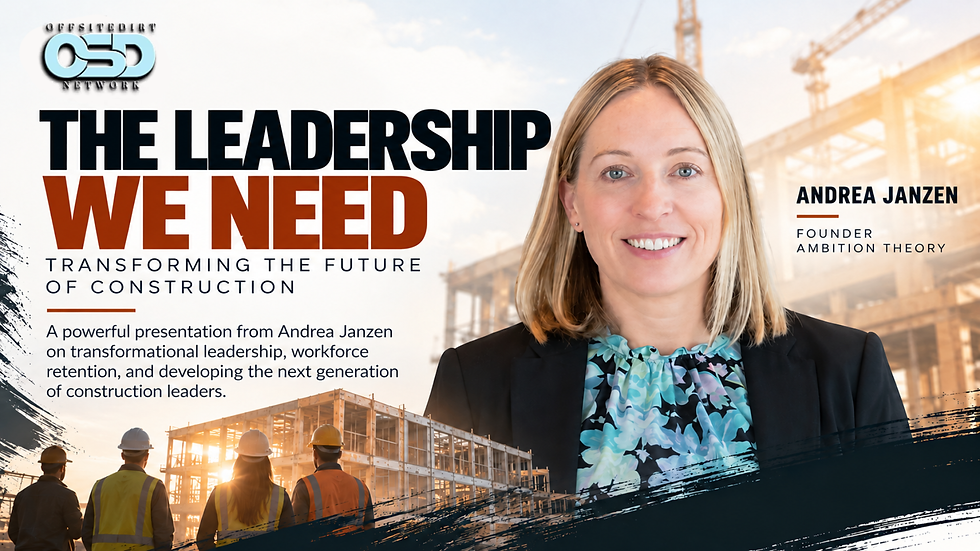
During the Offsite Construction & Leadership Series, powered by Becoming Human Again event in Denver, Andrea Janzen, founder of Ambition Theory, delivered an engaging presentation exploring the importance of transformational leadership, emotional intelligence, employee retention, and developing the next generation of construction leaders.
Drawing from her experience helping professionals advance into leadership roles, Janzen challenged attendees to rethink traditional management practices and consider how leadership development can help address some of the industry's most pressing workforce challenges.
Her central message was clear: The construction industry cannot simply recruit its way out of a leadership shortage. It must develop the people already within it.
From Supporting Women in Construction to Developing Leaders Across the Industry
Andrea Janzen's journey into construction leadership development began unexpectedly.
As she explained during her presentation, she did not begin her career as an engineer, architect, or construction professional.
Instead, she entered the industry through a passion for helping people connect their personal values with their professional ambitions. After developing a leadership workshop called Reignite Your Ambition, Janzen began searching for opportunities to share her message.
When she discovered an opening at the Groundbreaking Women in Construction conference in San Francisco, she reached out and offered to speak. Despite having limited speaking experience at the time, she was given a breakout session. She arrived with 50 handouts, expecting a small audience. Instead, the room filled completely, with attendees sitting on the floor and standing in the hallway.
The response confirmed that construction professionals were looking for more opportunities to develop leadership skills and connect their work with a greater sense of purpose. That experience helped launch Ambition Theory. Initially, the organization focused on helping women advance into leadership positions within construction.
Over time, however, Janzen began hearing the same feedback from participants: the leadership principles she was teaching were valuable for everyone. Ambition Theory eventually expanded its mission to help construction professionals of all backgrounds become influential leaders.
The Retirement Cliff: Construction's Growing Leadership Challenge
One of the most urgent issues Janzen addressed was what she called the retirement cliff.
Citing industry research, she explained that approximately 40% to 50% of construction leaders could retire by 2031. That creates a significant challenge for an industry already navigating workforce shortages and increasing project demands.
As experienced superintendents, project managers, executives, and other senior professionals retire, companies risk losing decades of institutional knowledge and leadership expertise. While recruiting younger workers is essential, Janzen emphasized that recruitment alone cannot solve the problem.
A student entering construction today cannot immediately replace a vice president of operations or a superintendent with decades of experience. Developing those capabilities takes time. And time is becoming increasingly limited.
Janzen encouraged construction organizations to think beyond attracting new employees and focus more intentionally on developing the people already working within their companies. The future of construction depends not only on who enters the industry, but on who is prepared to lead it.
Why Employees Leave: The Leadership Connection
Janzen also discussed research conducted by Ambition Theory in collaboration with the National Center for Construction Education and Research (NCCER). Through their Building Better reports, the organizations have examined workplace experiences, leadership development, and employee retention within construction. According to Janzen, ineffective leadership emerged as the leading reason respondents said they would consider leaving their jobs.
While compensation, career opportunities, and interesting projects remain important, the quality of leadership can have a significant influence on whether employees choose to stay.
She shared a comment from a construction project manager who explained that the most difficult part of the job was not necessarily the technical work, but navigating relationships with people.
This distinction matters. Technology can streamline processes, improve communication, and reduce administrative demands. But construction remains a people-driven industry. Projects depend on teams working together, solving problems, and making decisions under pressure. Without effective leadership, even the most advanced systems can struggle to deliver their full potential.
Transactional vs. Transformational Leadership
A major focus of Janzen's presentation was the difference between transactional and transformational leadership. She emphasized that neither approach is inherently better than the other. Both have important roles within construction. The challenge is understanding when each approach is most effective.
Transactional Leadership: Structure, Direction, and Accountability
Transactional leadership focuses on clear expectations, defined responsibilities, and established processes. Leaders set objectives, delegate tasks, monitor performance, and provide feedback based on results.
In construction, this approach is often essential. Projects operate within strict schedules, budgets, safety requirements, and contractual obligations. When a project falls behind schedule, leaders may need to establish clear deadlines and assign specific responsibilities.
In those moments, direct instruction and accountability can be the most effective approach.
However, Janzen cautioned against relying exclusively on this style. When leaders become overly focused on directing tasks, they may unintentionally discourage collaboration, creativity, and independent decision-making.
Transformational Leadership: Collaboration, Trust, and Growth
Transformational leadership takes a different approach. Rather than expecting leaders to solve every problem independently, it encourages them to involve their teams in finding solutions. Leaders still establish goals and expectations, but they also invite employees to contribute ideas, apply their strengths, and take ownership of outcomes.
For example, when an unexpected challenge arises on a construction project, a transactional leader might determine the solution and delegate the necessary tasks. A transformational leader might begin by bringing the team together and asking for their perspectives.
This creates opportunities to draw from a wider range of experience and expertise.
It also increases employee involvement and commitment. When team members participate in developing a solution, they are more likely to feel invested in making it successful.
The strongest leaders recognize that leadership is not simply about providing answers. It is also about creating opportunities for others to contribute.
The Cost of "That's How We've Always Done It"
Janzen shared a real-world example demonstrating how an over reliance on transactional leadership can create significant financial and operational consequences. During a construction project involving a car dealership, an experienced tile installer raised concerns about the conditions required to complete the work properly.
The building's windows had not yet been installed, and cold temperatures meant the installation membrane would not adhere correctly. The installer recommended covering the openings and heating the space before proceeding.
However, the superintendent was under pressure to maintain the project schedule. Rather than considering the installer's expertise, the superintendent instructed the worker to continue.
The result? The work had to be redone at an additional cost of approximately $35,000.
For Janzen, the financial impact was only part of the story. The situation also revealed the human consequences of a workplace where employees may not feel empowered to challenge decisions.
The installer recognized the problem but ultimately followed instructions. The superintendent prioritized the schedule without fully considering the technical concerns.
And the organization absorbed the cost of the resulting rework.
A more collaborative approach could have created an opportunity to pause, evaluate the conditions, and make a better-informed decision. The example reinforced an important lesson: listening to employees is not simply a matter of workplace culture. It can directly influence project quality, efficiency, and profitability.
Emotional Intelligence: Leading Above the Line
Throughout her presentation, Janzen introduced a practical emotional intelligence tool that Ambition Theory uses in its leadership development programs. The concept focuses on recognizing whether individuals are operating "above the line" or "below the line."
Below-the-line behaviors include:
Blaming others
Avoiding responsibility
Making excuses
Judging situations or individuals
Resisting change
Above-the-line behaviors include:
Taking ownership
Remaining curious
Seeking solutions
Asking thoughtful questions
Taking action
Janzen explained that these behaviors can influence the people around us.
When leaders consistently blame others or avoid accountability, those behaviors can spread throughout a team.
The opposite is also true. Leaders who demonstrate curiosity, ownership, and solution-focused thinking can encourage similar behaviors in their employees. Importantly, Janzen emphasized that everyone operates below the line at times.
The goal is not perfection.
It is awareness.
By recognizing our behaviors, we create opportunities to make different choices.
For construction leaders navigating difficult projects, workforce challenges, and organizational change, that awareness can be a valuable leadership skill.
Developing the Next Generation of Construction Leaders
As the industry prepares for significant generational transitions, Janzen encouraged organizations to reconsider how they approach younger employees. She explained that many experienced leaders developed their careers through years of technical work before advancing into management positions.
As a result, they may expect younger professionals to follow the same path.
But workforce expectations are evolving. Janzen highlighted that younger employees often want to understand the larger purpose behind their work and see a clear path for professional growth.
That does not necessarily mean expecting immediate promotions or higher salaries.
It means wanting to understand how their current responsibilities connect to future opportunities.
Rather than assigning tasks without additional context, leaders can create stronger engagement by explaining the bigger picture.
What is the company working toward?
What opportunities may become available?
How does an employee's contribution support the organization's goals?
These conversations help employees see themselves as part of something larger than their immediate assignments. For companies focused on retention, that sense of direction can make a meaningful difference.
From Mentorship to Sponsorship: Accelerating Leadership Development
One of the most practical strategies Janzen introduced was the shift from mentorship to sponsorship. While mentorship remains valuable, she explained that traditional leadership development can take 10 to 15 years.
With a growing number of experienced leaders approaching retirement, many organizations may not have that much time. Sponsorship offers another approach.
What Is the Difference Between Mentorship and Sponsorship?
Mentorship typically focuses on sharing knowledge, offering advice, and helping employees develop skills before taking on larger responsibilities. Sponsorship goes a step further. A sponsor actively creates opportunities for an employee to take on responsibilities they may not have experienced before.
Instead of waiting until someone is completely prepared, the sponsor provides the support and resources necessary for that person to learn through experience. Mistakes may happen. But with appropriate guidance and safeguards, those mistakes become learning opportunities rather than major setbacks.
Janzen suggested that sponsorship can help organizations accelerate leadership development, potentially reducing a traditional 10-to-15-year development path to approximately three to five years.
The goal is not to eliminate training or technical expertise. It is to create opportunities for employees to develop those capabilities while actively participating in meaningful work.
Leadership development cannot always wait until someone feels completely ready. Sometimes growth begins when someone is given the opportunity to try.
Creating Space for Strategic Leadership
Janzen also shared an example involving a national vice president who was struggling to balance strategic responsibilities with daily operational demands. As the organization expanded, the executive spent increasing amounts of time supporting less-experienced employees and responding to immediate questions.
The result was a calendar filled with meetings and very little time for long-term planning.
Although the executive's role required strategic thinking, much of the workday was spent managing individual tasks.
This situation highlighted another consequence of overly transactional leadership.
When employees depend on senior leaders for every decision, those leaders have less capacity to focus on the organization's future.
Developing employees who can make decisions independently is therefore not simply a professional development initiative. It is also a business strategy. By empowering teams and creating opportunities for growth, organizations can free experienced leaders to focus on innovation, expansion, and long-term planning.
The Power of Taking Action Within 24 Hours
Janzen concluded her presentation with an interactive coaching exercise designed to turn leadership concepts into practical action. Working with an attendee named Amanda, she explored how sponsorship could help address employee retention challenges within a large organization experiencing significant change.
The conversation focused on career development opportunities for engineers and the importance of helping employees understand their potential growth paths. Rather than attempting to solve the entire challenge at once, Janzen encouraged Amanda to identify one specific action she could take within 24 hours.
That action involved initiating a conversation with a senior leader about opportunities to connect career development with meaningful projects. The exercise illustrated a central principle of Ambition Theory's approach.
Meaningful organizational change rarely happens through one major initiative. It begins with small, intentional steps. A conversation. A question. An opportunity offered to an employee. A decision to approach a familiar problem differently.
Janzen emphasized that building a stronger workplace culture takes time, just as constructing a building requires planning, coordination, and consistent effort. But progress begins when individuals take action.
Building the Leaders Construction Needs
The construction industry is entering a period of significant transition. Experienced professionals are approaching retirement, younger generations are entering the workforce with evolving expectations, and technological advancements continue to reshape how projects are delivered.
Meeting these challenges will require more than recruiting additional workers or implementing new systems.
It will require leaders who can adapt, collaborate, communicate, and empower others.
Andrea Janzen's presentation at Becoming Human Again demonstrated that effective leadership is not defined solely by authority or job titles.
It is defined by influence. Every professional who works with others has an opportunity to lead through their actions, decisions, and relationships. By combining transactional structure with transformational leadership, organizations can strengthen employee engagement, improve retention, and create more opportunities for professional growth.
And by shifting from mentorship alone to active sponsorship, construction companies can begin preparing the next generation of leaders before the retirement cliff creates an even larger gap. The future of construction will not be shaped only by the technologies we adopt or the projects we complete. It will be shaped by the leaders we develop along the way.
Continuing the Becoming Human Again Conversation
Andrea Janzen's presentation at the Becoming Human Again event in Denver reinforced the importance of investing in people as the construction industry continues to evolve.
Through Ambition Theory, Janzen is helping construction professionals develop the confidence, emotional intelligence, and leadership skills needd to navigate change and create meaningful impact.
Her message serves as a reminder that leadership development is not simply an organizational benefit. It is an essential part of building a sustainable future for the construction industry.
Learn more about upcoming Becoming Human Again events at https://www.becominghumanagainevents.com
Explore more industry stories, insights, and expert conversations at https://www.offsitedirtnetwork.com/
Frequently Asked Questions (FAQs)
1. What is transformational leadership, and why is it important in construction?
Transformational leadership is an approach that emphasizes collaboration, trust, employee development, and shared problem-solving. Unlike traditional transactional leadership, which focuses primarily on tasks, hierarchy, and performance expectations, transformational leadership encourages employees to contribute ideas and take ownership of outcomes. In construction, this approach can strengthen communication, improve employee engagement, and help teams navigate complex project challenges.
2. How can construction companies prepare for the upcoming leadership retirement cliff?
Construction companies can prepare by investing in leadership development, strengthening employee retention, and creating opportunities for emerging professionals to gain practical leadership experience. Andrea Janzen recommends combining mentorship with sponsorship, where experienced leaders actively provide employees with new responsibilities and appropriate support. This approach can help accelerate professional growth and prepare future leaders before experienced employees retire.
3. What were the key takeaways from Andrea Janzen's presentation at Becoming Human Again?
Andrea Janzen emphasized the importance of transformational leadership, emotional intelligence, and proactive leadership development within construction. Her presentation explored the financial and cultural costs of overly transactional management, the changing expectations of younger professionals, and the need to develop future leaders through sponsorship. She also introduced practical tools, including above-the-line thinking and 24-hour actions, to help construction professionals begin implementing meaningful change.
#OffsiteDirtNetwork #BecomingHumanAgain #AndreaJanzen #AmbitionTheory #ConstructionLeadership #TransformationalLeadership #LeadershipDevelopment #OffsiteConstruction #IndustrializedConstruction #WorkforceDevelopment #ConstructionIndustry #EmployeeRetention #EmotionalIntelligence #WomenInConstruction #FutureOfConstruction


Comments